
Key Takeaways
- Refraction is the part of your eye exam that determines your prescription for glasses or contact lenses.
- It checks for nearsightedness, farsightedness, and astigmatism.
- Refraction is separate from the medical portion of a full eye exam.
- Medicare typically does not cover refraction, but vision insurance, HSA, and FSA funds can often cover it.
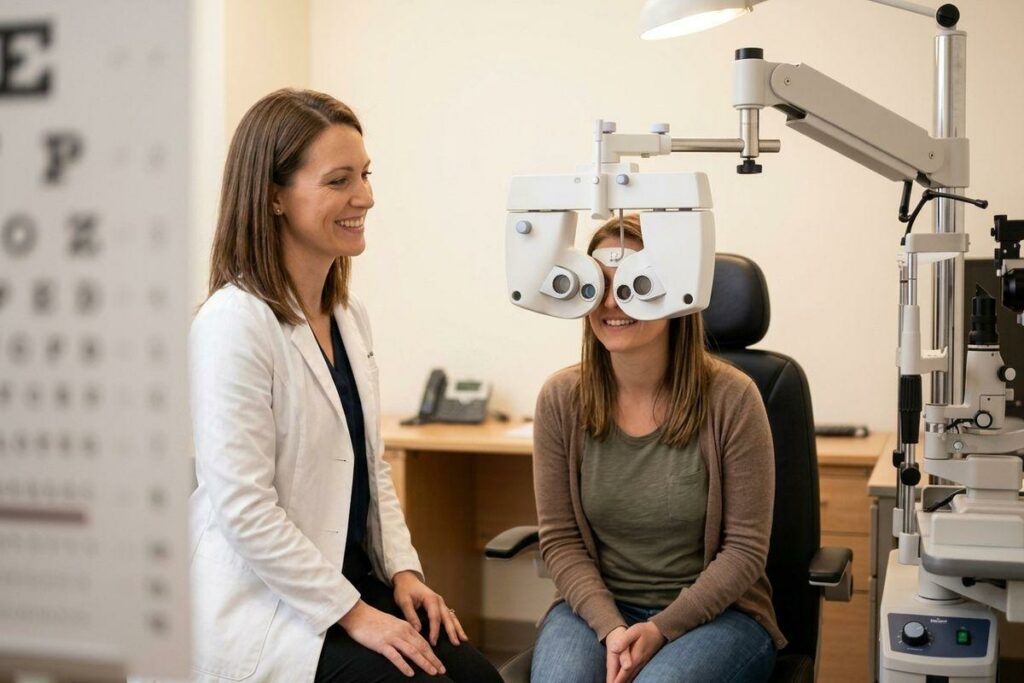
You sit down in the exam chair, a large device swings in front of your face, and the eye doctor starts asking, “Which is clearer, one or two?” It’s one of the most familiar moments in any eye exam, but most people have no idea what it’s actually measuring or why it matters.
This process is called refraction, and it is how your eye doctor determines the exact prescription required to bring your vision into sharp focus. It is a quick, essential step that helps you walk out of your appointment with a prescription tailored specifically to your needs. Of course, a comprehensive eye exam goes well beyond finding your prescription. It is a full check-up for your overall eye health.
The Role of Refraction in Your Eye Exam
Think of refraction as the “prescription-finding” part of your visit. Your eye doctor uses a phoropter (that familiar, goggle-like instrument with dozens of lenses built in) to swap between different options while you decide which one makes the letters on the chart look sharper.
This part of the exam focuses entirely on your visual clarity. It is distinct from the medical portion, where your eye doctor checks the underlying health of your eyes for signs of disease or damage. While both serve different purposes, they are equally important, which is why routine exams are recommended every 1 to 2 years for adults and annually for children.
What Refraction Can Detect
Refraction helps your eye doctor pinpoint three main types of vision errors. While each one affects how clearly you see, they occur in different ways:
- Nearsightedness (myopia): Distant objects appear blurry, such as road signs or a whiteboard at the front of a room.
- Farsightedness (hyperopia): Close-up objects are harder to see clearly, making text on a phone or book difficult to read.
- Astigmatism: Vision is blurry at multiple distances because the shape of the eye scatters light rather than focusing it perfectly.
How Light and Your Eyes Work Together
When light enters your eye, it needs to bend and land directly on your retina, which is the light-sensitive layer at the back of your eye. When that happens, you see a sharp, clear image.
If the light lands a little in front of or behind your retina, things look blurry. Your prescription is essentially a correction that guides light to exactly the right spot.
What to Expect During a Refraction
This process is straightforward, quick, and requires no drops or special preparation. Here is what you can expect:
- The baseline: Your eye doctor may start with an autorefractor, a machine that provides an initial, automated reading of your eyes to guide the rest of the testing.
- The phoropter: You will look through that familiar, goggle-like instrument at a letter chart while your eye doctor swaps between various lenses.
- The comparison: As you choose which lens option looks clearer, your eye doctor fine-tunes the settings until your vision reaches its peak sharpness.
The entire process typically takes just a few minutes. Your feedback during those “one or two?” comparisons is what allows your eye doctor to pinpoint your ideal prescription. If you are curious about the total time investment, routine eye exams typically last between 30 and 60 minutes, depending on the specific services included in your visit.
Your Resulting Prescription
Once the refraction is done, you’ll have a written prescription. It reflects the lens strength your eyes need to see clearly, and it may address one or more vision errors at the same time.
For example, someone can be both nearsighted and have astigmatism, and a single prescription can cover both. Keep in mind that glasses and contact lens prescriptions are not the same, so you may need separate exams if you wear both.
Refraction vs. a Full Eye Exam
Refraction tells your eye doctor what prescription your eyes need. A full eye exam goes further. During a complete visit, your eye doctor also checks the health of your eyes, looking for signs of conditions like glaucoma, cataracts, or retinal changes that don’t usually have anything to do with your prescription.
Skipping refraction means leaving without a prescription. Skipping the health portion may mean missing problems that develop quietly without symptoms. Both are part of a thorough visit with an optometrist in Broomfield, and both give you a clearer picture of your overall eye health. In fact, a full eye exam can detect over 270 health conditions, including diabetes and high blood pressure, making it far more than just a vision check.
Refraction and Insurance Coverage
Why Insurance Often Skips It
Refraction is classified as a vision service rather than a medical service. That distinction matters because Medicare, which covers many medical services, typically does not cover refraction. This surprises many people at checkout.
Ways to Cover the Cost
The good news is that you likely have options. A few common ways to cover refraction costs include:
- Vision insurance plans, which often include refraction as part of a routine exam benefit
- HSA or FSA funds, which can usually be applied toward the cost
We’re Here to Help
If you’re unsure what your plan covers, our team at Visionary Eye Care Colorado can help you sort through your options before your visit. Reach out today to schedule your eye exam and get answers to any questions you have about refraction, coverage, or what to expect at your appointment.